
Procedure guide
Middle ear testing: what to know before, during and after
How tympanometry works, what the tracing shows, and how I'd use the result for you or your child.
The short answer
- Tympanometry measures how well the eardrum moves. A soft probe in the ear canal changes the air pressure slightly for a few seconds and draws a tracing. It's painless and works even in a toddler.
- A flat tracing usually means fluid behind the eardrum, which the test detects about 94% of the time. It shows how the middle ear is working. It isn't a hearing test, and it can't tell infected fluid from uninfected fluid.
Looking at an eardrum tells me a lot, but not everything. Fluid can sit behind an eardrum that looks nearly normal, and a squirming two-year-old doesn't give me long to look. Tympanometry is a quick, objective way to check how the eardrum and the space behind it are working. It's especially helpful for children with repeated ear infections, lingering fluid or concerns about hearing and speech.
Education, not a diagnosis
This guide explains what the test involves. It doesn't replace an exam, or advice about your own or your child's ears.
How tympanometry works
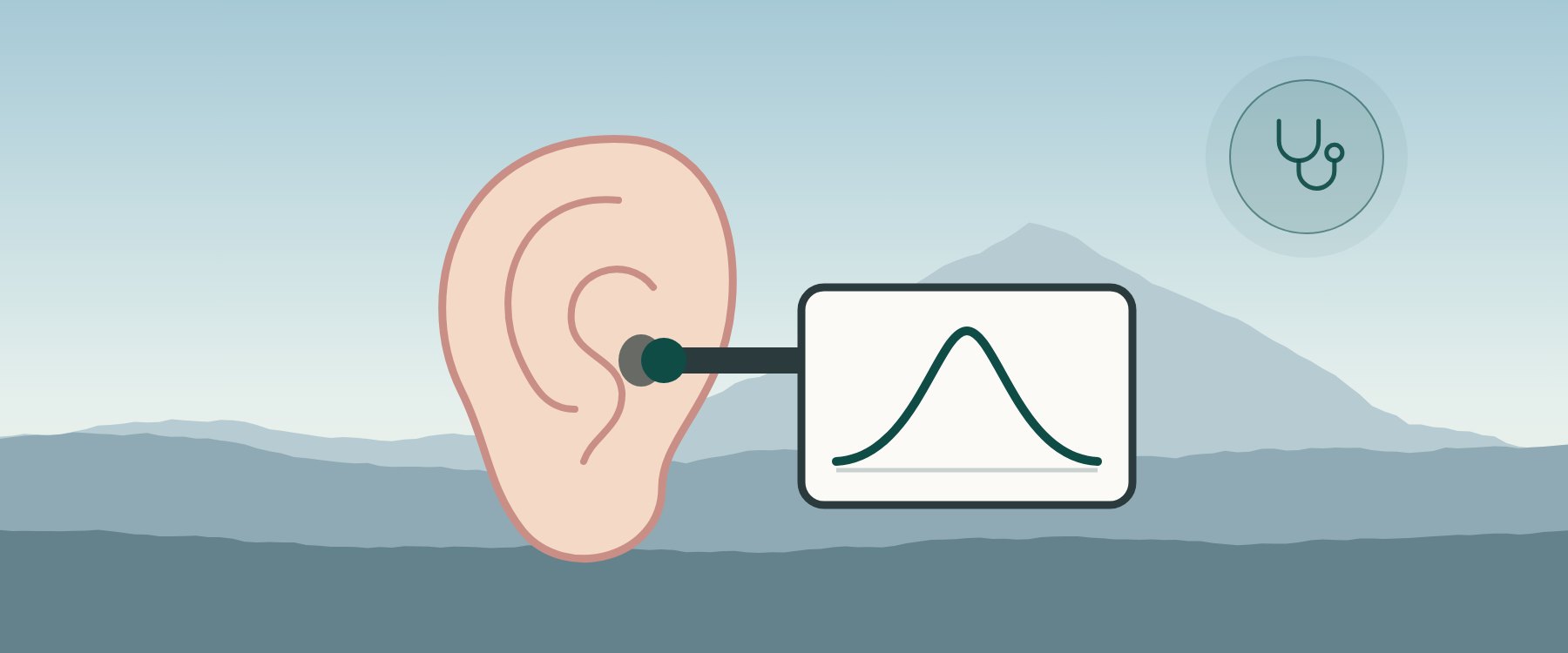
The middle ear is an air-filled space behind the eardrum, connected to the back of the nose by the eustachian tube. A healthy eardrum is springy and moves most freely when the air pressure is equal on both sides. A soft-tipped probe is placed snugly in the ear canal. It plays a quiet tone, gently raises and lowers the air pressure in the canal, and measures how much sound bounces back. A stiff eardrum, such as one with fluid behind it, reflects more sound. The device draws a curve called a tympanogram and also measures the volume of the ear canal.
| Tracing | What it usually means | |
|---|---|---|
| Type A | A normal peak near zero pressure | A healthy middle ear with a freely moving eardrum |
| Type B, normal canal volume | Flat, with no peak | Fluid behind the eardrum |
| Type B, large canal volume | Flat, with no peak | A hole in the eardrum, or an ear tube that's open and working |
| Type B, small canal volume | Flat, with no peak | Wax blocking the canal, or the probe against the canal wall |
| Type C | A peak shifted to negative pressure | A eustachian tube that isn't opening well, often during or after a cold; the eardrum is pulled inward |
| Very shallow or very tall peak | Types As and Ad | A stiff eardrum or middle ear bones, or an unusually floppy eardrum |
Who it's for
- Children with possible fluid behind the eardrum, especially when it has lasted for weeks or keeps coming back.
- Concerns about hearing, speech or school performance in a child, where long-standing fluid may be the reason.
- Checking ear tubes, to see whether a tube is still open.
- Ear fullness, popping or muffled hearing in adults, such as after a cold or a flight, to look for eustachian tube problems.
- An uncertain exam, when I can't be sure by looking whether there's fluid.
Who should skip it, or needs something else
- Babies under 7 months. Their ear canals are so soft that standard results are unreliable.
- A very painful ear, drainage, or recent ear surgery, where a probe in the canal isn't comfortable or appropriate.
- A canal blocked with wax, which needs to be cleared first.
- Hearing loss. Tympanometry doesn't measure hearing. That takes an audiogram.
Benefits and limits
Benefits
Fast, painless and objective. No cooperation needed beyond sitting still for a few seconds. Detects fluid that's hard to see, and gives a record to compare over time.
Limits
It can't tell infected fluid (an ear infection) from uninfected fluid, so the exam still matters. It isn't a hearing test. A usable tracing can't be obtained in some ears, mostly because of movement or a poor seal.
Common risks
A brief feeling of pressure or fullness, like in an elevator, and a soft hum. Some children dislike having anything in the ear.
Rare risks
Brief discomfort if the ear is already inflamed. There are no lasting risks, and no radiation.
Fluid isn't always infection
Fluid behind the eardrum is common after a cold or an ear infection, and in most children it clears on its own within three months. It doesn't need antibiotics unless there are signs of infection. If it lasts longer than three months, or hearing or speech is affected, the next steps are a hearing test and a visit with an ear specialist.
Alternatives
- Pneumatic otoscopy, where I look at the eardrum while giving a small puff of air to see whether it moves. It's about as accurate in practiced hands, and I'd usually do both.
- Watching and rechecking in a few weeks.
- A formal hearing test with an audiologist, when hearing is the question.
Step by step
- LookI examine the ear canal and eardrum first, and clear any wax that would block the probe.
- FitA soft tip, sized to the ear, is placed at the opening of the canal to make an airtight seal. A child can sit in a parent's lap.
- MeasureYou hear a low hum and feel a slight pressure change for a few seconds. Staying still and quiet, without talking or swallowing, gives the best tracing.
- RepeatThe other ear is tested the same way.
- ReviewThe tracings print or display right away, and we go over them together.
Afterward
The short version
There's nothing to do afterward. The result is ready on the spot, and the plan depends on what it shows.
- Normal tracing: the middle ear is working, and we look elsewhere for the cause of the symptoms.
- Fluid: usually watchful waiting, with a recheck in a few weeks to see that it's clearing.
- Negative pressure: often settles as a cold resolves. Yawning, swallowing and chewing gum help the eustachian tube open.
- A hole in the eardrum or a blocked tube: keeping the ear dry and, in some cases, a referral.
When to call
- Ear pain, fever, or drainage from the ear.
- Hearing that seems worse, or a child who isn't responding to sound as usual.
- Dizziness or ringing in the ear.
- Speech that isn't progressing in a young child.
Which procedures Peak Health offers in the office will be confirmed before opening. You can see the full list on the Services page, and the rest of these guides in the procedure guides library.
Sources: Onusko E. Tympanometry. American Family Physician. 2004;70(9):1713–1720. aafp.org. Harmes KM, Blackwood RA, Burrows HL, et al. Otitis media: diagnosis and treatment. American Family Physician. 2013;88(7):435–440. aafp.org. Rosenfeld RM, Shin JJ, Schwartz SR, et al. Clinical practice guideline: otitis media with effusion (update). Otolaryngology–Head and Neck Surgery. 2016;154(1 Suppl):S1–S41.
Join the waitlist
Peak Health is not open yet. It opens for direct primary care in Colorado Springs after Dr. Bennett's Army service ends. People on the waitlist hear first and are offered membership first.
No payment and no commitment.