
Procedure guide
Botox for chronic migraine: the injection map, step by step
What Botox does for chronic migraine, exactly where the 31 injections go and why, the results you can expect, the side effects, and the steps and aftercare I'd go over with you first.
The short answer
- Botox is FDA approved to prevent headaches in adults with chronic migraine, meaning headaches on 15 or more days a month. The label dose is 155 units, given as 31 small injections of 5 units each into 7 muscle areas of the head and neck, every 12 weeks.
- In the two trials behind the approval, it cut headache days by about 8 to 9 days a month, compared with about 6 to 7 on placebo. Judge it after at least two rounds. Neck pain is the most common side effect, and Xeomin is sometimes used off label with the same doses and sites.
If you have a headache more days than not, a daily pill isn't the only way to prevent them. Botox, the same medicine used for frown lines, has been FDA approved to prevent chronic migraine since 2010. Every 12 weeks it's injected into a fixed pattern of 31 spots across the forehead, temples, back of the head, neck and shoulders. It isn't a cure, and it takes patience, but for many people it means far fewer headache days.
Education, not a consent form
This guide explains what a consent visit covers. It doesn't replace the conversation and signed form before your own treatment.
What Botox for migraine is
Botox (onabotulinumtoxinA) is a purified protein that blocks the signals nerve endings send. In a muscle, it stops the chemical that tells the muscle to contract, so the muscle relaxes. For migraine, the more important effect seems to be on the pain nerves. Botox is thought to block the release of pain and inflammation chemicals such as CGRP, substance P and glutamate from the nerve endings in the scalp and neck. That quiets the nerves that carry headache pain, and over time, fewer signals reach the brain to set off an attack.
That's why the injections follow nerves, not just tight muscles. The 31 sites cover the forehead and temples, served by the trigeminal nerve, and the back of the head and neck, served by the occipital nerves. Those are the two nerve systems most involved in migraine pain.
Who it's for
- Adults with chronic migraine: headaches on 15 or more days a month, each lasting 4 hours or more, for at least 3 months, with migraine features on most of them. That's the group the FDA approved it for.
- People who have tried, can't tolerate or don't want daily preventive pills, or who want an option with no daily dose.
- People who will keep a headache diary. A month of tracking before the first treatment confirms the diagnosis, and it's how you'll know whether it's working.
It isn't approved for episodic migraine (14 or fewer headache days a month), where it hasn't been shown to work, or for other headache types such as tension headaches.
Who should wait, or see a specialist
- An allergy to any botulinum toxin product or its ingredients.
- An infection where the injections would go.
- A nerve and muscle condition such as myasthenia gravis, Lambert-Eaton syndrome, ALS or a motor neuropathy. Botox can cause serious weakness, including trouble swallowing or breathing, so this needs a neurologist's plan.
- Trouble swallowing or breathing already, or a weak neck.
- Pregnancy or breastfeeding. There isn't enough human data, so we'd choose another option.
- Certain medicines, including aminoglycoside antibiotics and muscle relaxants, which can strengthen the effect, and any other recent botulinum toxin treatment.
- A new or changing headache pattern, a headache that's the worst of your life, or headaches with weakness, numbness, confusion or fever. Those need an evaluation first, not prevention.
- Daily use of pain relievers. Taking headache medicine on 10 to 15 or more days a month can cause rebound headaches. We'd work on that alongside any prevention.
The injection map
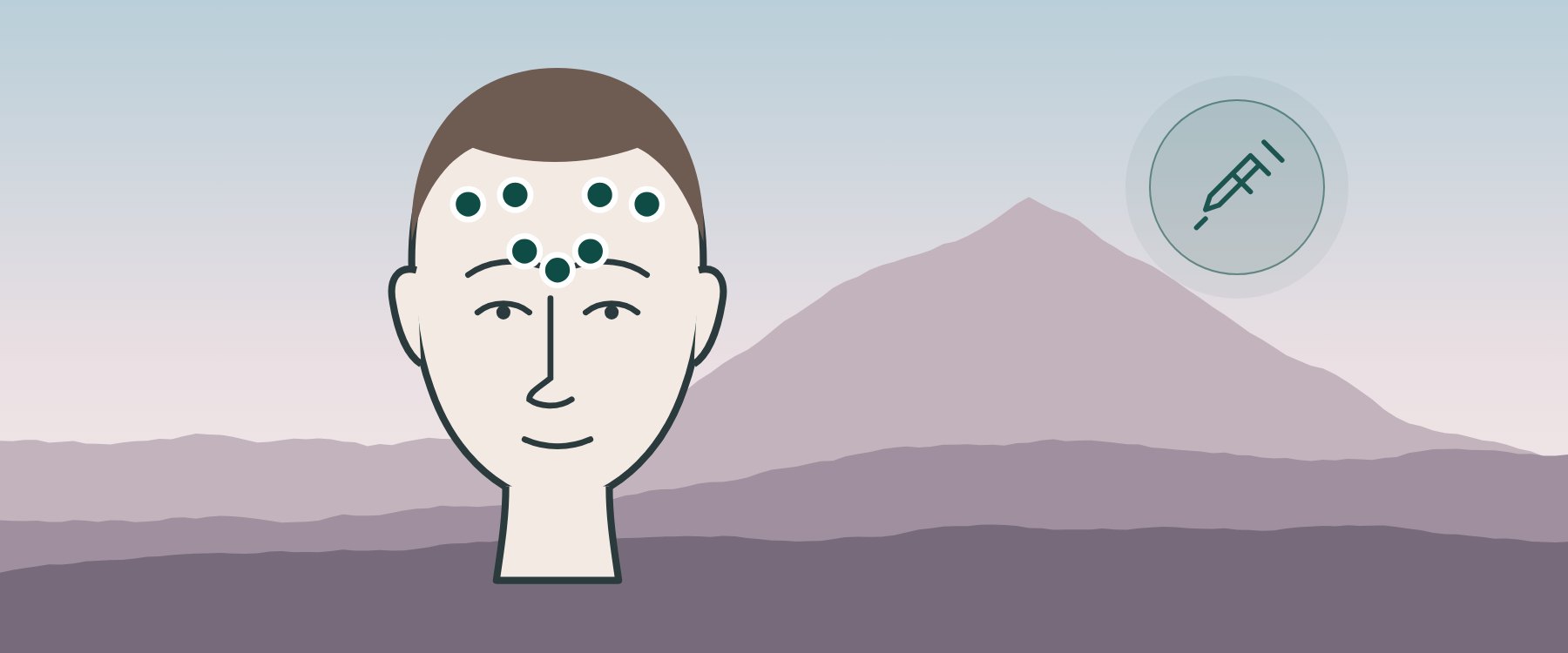
The FDA label sets a fixed pattern: 31 injections of 5 units (0.1 mL each) into 7 muscle areas, half on the left and half on the right, except the procerus, which gets one injection in the middle. Tap a muscle to see where it is, how much it gets and why it's included.
Tap a muscle above to see its dose and why it's injected. All 7 areas together: 155 units at 31 sites.
| Muscle area | Dose (label) | Where |
|---|---|---|
| Frontalis | 20 units, 4 sites | Forehead, 2 on each side, well above the brows |
| Corrugator | 10 units, 2 sites | Just above the inner end of each brow |
| Procerus | 5 units, 1 site | Between the brows, in the middle |
| Temporalis | 40 units, 8 sites | Temples, 4 on each side |
| Occipitalis | 30 units, 6 sites | Back of the head, 3 on each side |
| Cervical paraspinal | 20 units, 4 sites | Back of the upper neck, 2 on each side of the spine |
| Trapezius | 30 units, 6 sites | Top of the shoulders, 3 on each side |
| Total | 155 units, 31 sites | Every 12 weeks |
The label calls for a 30-gauge, half-inch needle, or a 1-inch needle in the neck if the muscles are thick, and Botox diluted to 5 units per 0.1 mL. In the trials, some people also got up to 40 extra units in the areas that hurt most, a "follow the pain" approach, for up to 195 units. The FDA-approved dose is 155 units, and that's what I'd use.
How it helps
A migraine starts when overactive pain nerves around the head and neck fire and release inflammatory chemicals. With chronic migraine, those nerves, and the parts of the brain that receive their signals, become more and more sensitive, so attacks start more easily and last longer. Botox is thought to break that cycle in three ways:
- It quiets the pain nerve endings. By blocking the release of CGRP, substance P and glutamate, it lowers the inflammation around the nerves in the scalp and neck.
- Fewer pain signals reach the brain, which over time can lower the brain's sensitivity, so it takes more to set off an attack.
- It relaxes tight muscles in the forehead, temples, neck and shoulders, which many people feel tighten during an attack.
Because it works on nerve sensitivity rather than numbing pain on the spot, it takes time. Some people notice a change after the first round. A good number only improve after the second.
Benefits and risks
Benefits
Fewer headache days and fewer hours of headache. No daily pill. Effects last about 3 months per treatment. Approved by the FDA for this use since 2010, with a decade and a half of experience.
Common risks
Neck pain (9% vs. 3% on placebo), headache or migraine right after treatment, and brief soreness or bruising at the injection sites.
Less common risks
A drooping eyelid (4% vs. under 1%), neck or shoulder weakness or stiffness (about 4%), a heavy or lowered brow, or an uneven forehead. These wear off as the medicine does.
Rare risks
Spread of the effect beyond the injected muscles, causing trouble swallowing, speaking or breathing, which is the FDA's boxed warning for all botulinum toxins. An allergic reaction. Infection.
What the trials showed
The approval rests on two 24-week trials with 1,384 adults with chronic migraine. After two treatments, people on Botox had 7.8 and 9.2 fewer headache days a month, compared with 6.4 and 6.9 fewer on placebo. They also had far fewer total hours of headache. The difference over placebo is about 1.5 to 2.5 headache days a month, on top of a large placebo effect, so it helps to know your own numbers before and after. That's why the headache diary matters.
Common side effects, and how to handle them
| Side effect | How often (Botox vs. placebo) | What to do |
|---|---|---|
| Neck pain | 9% vs. 3% | Heat, gentle stretching and your usual pain reliever. It usually settles within days. |
| Headache or a migraine afterward | 5% vs. 3% and 4% vs. 3% | Treat it the way you usually would. It doesn't mean the treatment failed. |
| Drooping eyelid | 4% vs. under 1% | It wears off over weeks. Let me know, since prescription eye drops can lift the lid a little in the meantime, and the next round's forehead sites can be adjusted. |
| Neck weakness or stiffness | About 4% each vs. 1% or less | Avoid heavy overhead lifting until it eases. Tell me if your head feels hard to hold up, and the neck doses can be adjusted next time. |
| Muscle aches or injection-site pain | 3% each | Ice for 10 minutes, and avoid rubbing the areas that day. |
Xeomin and other botulinum toxins
Botox is the only botulinum toxin FDA approved for chronic migraine. Xeomin (incobotulinumtoxinA) isn't approved for migraine, but it's often used off label in the same way: the same 155 units, the same 31 sites, the same technique and the same 12-week schedule. It's the same toxin type without the extra carrier proteins, and it's commonly dosed unit for unit with Botox. A Navy-run trial at Naval Medical Center Camp Lejeune is comparing the two head to head at exactly that dose, describing the products as comparable at a 1:1 ratio. A small study of 38 people treated with Xeomin at the same 31 sites reported fewer monthly headache episodes, though it had no placebo group.
Two cautions. The Botox label notes that units of different toxin products aren't automatically interchangeable, so a switch should be a deliberate decision with your doctor, not a pharmacy substitution. And off-label use means insurance may not pay for it, so check coverage before you start.
Alternatives
- Daily preventive pills: certain blood pressure medicines, antidepressants and anti-seizure medicines. They're inexpensive, and many people start with one of these.
- CGRP-blocking medicines: monthly or quarterly injections that block CGRP or its receptor, and daily preventive tablets in the same family.
- Nerve blocks: numbing medicine injected around the occipital nerves at the back of the head, which can calm a long run of headaches. See my guide to numbing medicine and nerve blocks.
- The basics, every time: regular sleep, meals and exercise, limiting acute headache medicine to fewer than about 10 days a month, and managing triggers you've found in your diary.
Step by step
- DiaryTrack your headache days, how long each lasts and what you took, for at least a month before the first visit.
- ConsentWe go over your history, the benefits, risks and alternatives, and you sign a consent form. I check for allergies, nerve and muscle conditions, pregnancy and medicines that interact.
- SetupYou sit upright. The skin is cleaned. Each dose is drawn up at 5 units in 0.1 mL.
- Injections31 quick, shallow injections with a very fine needle: forehead and brows, then temples, then the back of the head, neck and shoulders. Each one feels like a brief sting and a little pressure. The injections themselves take only a few minutes.
- CheckA short wait to make sure you feel well, then you can drive yourself home and go back to work.
- Follow-upA check-in about 4 to 8 weeks after the first round, then treatment every 12 weeks. We judge it after at least two rounds.
Aftercare
- Small bumps and pinpoint bleeding are normal and fade within an hour or so.
- Don't rub or massage the injected areas that day.
- Keep your headache diary going, and bring it to every visit. It's how we decide whether to continue.
- Book your next round for 12 weeks out. Many people notice the effect wearing off toward the end of the cycle.
- Keep taking any other preventive medicine unless we've agreed to change it.
When to call
- Call 911 for trouble breathing, swallowing or speaking, or sudden weakness all over. These can start hours to weeks after treatment.
- Call me the same day for double or blurred vision, a drooping eyelid, a neck too weak to hold your head up comfortably, hoarseness, or signs of an allergic reaction such as hives or swelling.
- Call me for redness, warmth or pus at an injection site, or a fever.
- Get seen urgently for a sudden, severe "worst ever" headache, or a headache with weakness, numbness, confusion, fever or a stiff neck. Those aren't a Botox side effect and need an emergency evaluation.
Common questions
How many injections is Botox for chronic migraine?
The FDA-approved protocol is 31 injections of 5 units each, for 155 units in total, into 7 muscle areas: the forehead, between the brows, the temples, the back of the head, the upper neck and the tops of the shoulders.
How often do you get Botox for migraines?
Every 12 weeks. Many people notice it wearing off toward the end of each cycle.
How long does Botox take to work for migraines?
Some people notice fewer headache days after the first round, but a good number only improve after the second, so it's judged after at least two treatments.
Who qualifies for Botox for migraines?
Adults with chronic migraine, meaning headaches on 15 or more days a month, each lasting 4 hours or more. It isn't approved for episodic migraine, with 14 or fewer headache days a month.
Can Xeomin be used for migraines instead of Botox?
Xeomin isn't FDA approved for migraine, but it's often used off label with the same 155 units, the same 31 sites and the same technique, dosed unit for unit with Botox. Insurance may not cover it for this use.
What are the side effects of Botox for migraines?
Neck pain is the most common, in 9% of people in the trials compared with 3% on placebo. A drooping eyelid, neck weakness or stiffness, and a headache right after treatment each happened in about 4% to 5%.
Sources: BOTOX (onabotulinumtoxinA) prescribing information, Allergan: indications, chronic migraine dosing (Table 2), warnings, adverse reactions (Table 15) and clinical studies (Section 14). Label PDF. Marmura MJ. OnabotulinumtoxinA for headache: an update. Practical Neurology. January–February 2012. practicalneurology.com. Naval Medical Center Camp Lejeune. BOTOX vs. XEOMIN for Chronic Migraine (NCT05598723), ClinicalTrials.gov listing. ctv.veeva.com. Benítez Salazar JM, Pérez García JC, et al. Pilot study on the efficacy of incobotulinumtoxin-A for refractory chronic migraine. American Academy of Neurology Annual Meeting, 2025 (abstract). AAN 2025 abstract.
Join the waitlist
Peak Health is not open yet. It opens for direct primary care in Colorado Springs after Dr. Bennett's Army service ends. People on the waitlist hear first and are offered membership first.
No payment and no commitment.